Starting a New Job with ADHD: Setting Up Your Money Before the First Payday

Starting a new job takes up almost all of your attention. There's a new building, new names, new logins, and the pressure of trying to present well. Money admin is usually the last thing your brain has room for, right when it matters most.
When a big life change collides with a neurodivergent brain, financial admin can be challenging. This is about getting a few small things in place before payday, so the transition doesn't quietly turn into a financial mess.
What it looks like
The chaos of starting a new job rarely shows up as one big problem. It's usually a pile of small ones:
- You're not sure exactly when your first payment will land or how the pay cycle works.
- Direct debits are still being taken from an account that assumes your old income pattern.
- Subscriptions, apps, or perks tied to your last job keep charging you.
- You know you should check all of this, but opening your banking app feels like one more thing you can't face this week.
That last point is common enough to have a name. If avoidance is the main thing standing between you and your accounts right now, this may be useful: More here: Shame and Avoidance Cycles in Neurodivergent Adults (https://neuromoney.io/blog-shame-avoidance.html)
Why it happens
Job transitions ask you to hold a lot of new, unfamiliar information in mind at once, at exactly the moment your existing financial admin still needs tracking too. That's a heavy working memory load, and ADHD brains often have less spare capacity for it.
Research on financial decision-making in adults with ADHD has found a pattern worth naming: people are more likely to use an avoidant or spontaneous decision style, and less likely to save, when things get financially uncertain (Bangma et al., 2020). Avoiding your accounts during a chaotic week is a documented pattern.
There's also a timing piece. Payday dates, notice periods, and gap-between-jobs windows all involve holding a mental countdown of "how many days until X." A large meta-analysis found consistent timing and time-perception differences in ADHD (Marx et al., 2021), which helps explain why “my first payday is sometime in the following weeks” can feel almost impossible to pin down without writing it somewhere visible.
If tracking dates and deadlines is a recurring struggle for you, not just during job changes, this goes into it in more depth: More here: Time Blindness: What is it and what actually helps (https://neuromoney.io/blog-time-blindness.html)
What helps
You don't need a full financial overhaul before you start. A few small, concrete steps can cover most of the risk.
Before your first day, if you can:
- Find your exact pay date and pay frequency in your contract or offer letter. Write it somewhere you'll actually see it, not just somewhere you filed it.
- Check whether there's a gap between your last payslip and this one, and roughly how big it is.
- If you have any spare buffer, move enough into your everyday account to cover essentials until that first payday clears.
In your first week or two:
- Make one simple list of everything that leaves your account regularly: rent or mortgage, phone, subscriptions, anything linked to your old workplace (like a gym perk or expensed tool). You're not reorganizing anything yet, just seeing it all in one place.
- If any of those were tied to your old job or income, flag which ones need updating.
A lot of these recurring charges hide in plain sight, especially the ones you signed up for once and forgot about. If that's part of what's cluttering things right now: More here: The "Invisible Subscriptions" Trap (And Why Our Brains Struggle) (https://neuromoney.io/blog-invisible-subscriptions.html)
Keep new decisions small for now. This isn't the week to switch banks, open a savings account, or restructure your budget. New job plus new financial system is a lot of change at once. Let the job settle first.
Some people find an ADHD money management tool helps reduce decision fatigue by keeping basics in one place during a stretch like this, but the best system is the one you'll still use when you're tired.
Template email to HR
Hi [HR or payroll name],
I’m looking forward to joining on [start date].
Before my first day, could you please confirm my first payday and whether that payment will cover the full period from my start date?
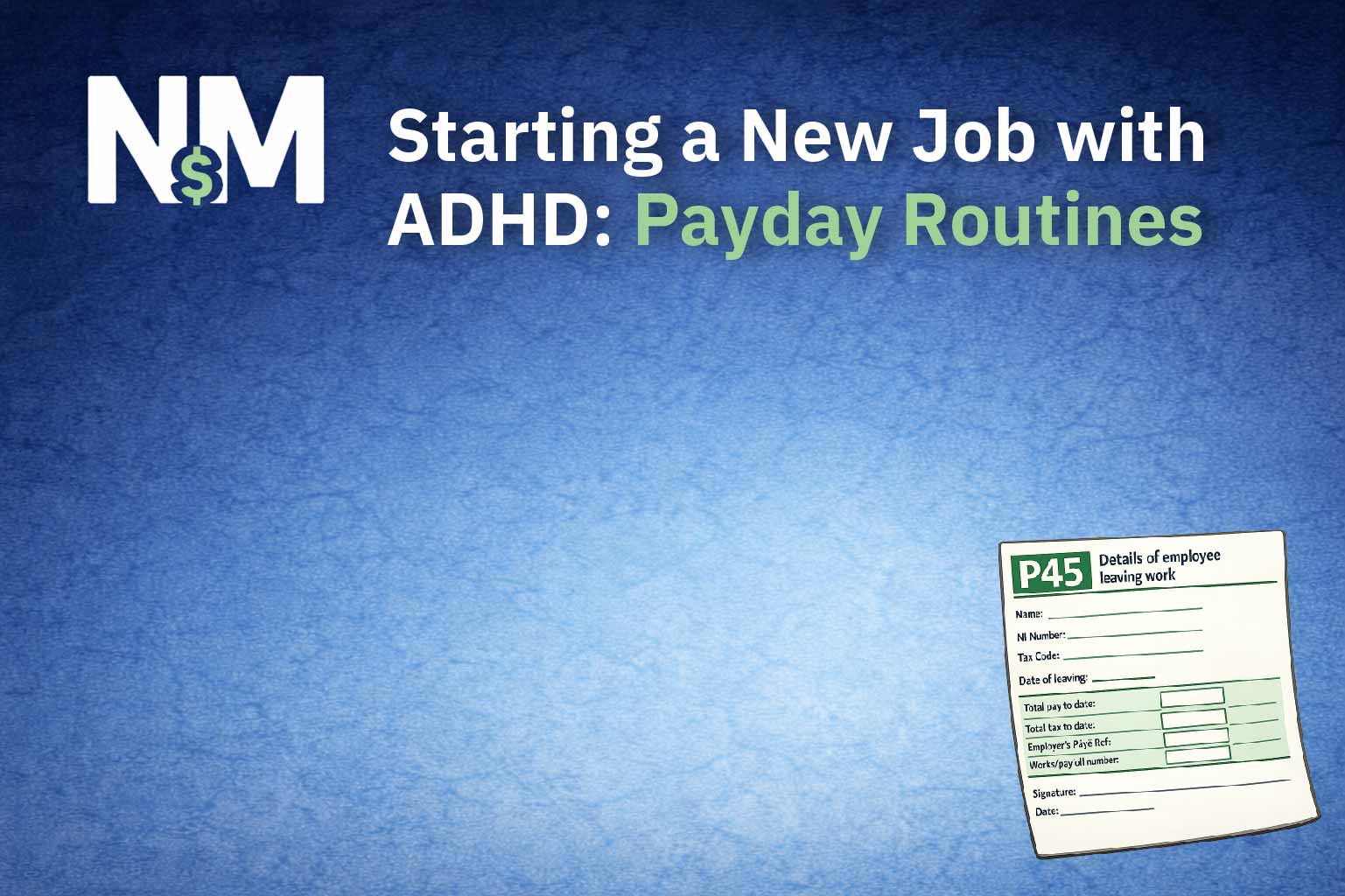
Could you also let me know whether you need my P45 or a starter checklist, and where I should send any payroll information?
Thanks,
[Your name]
If something slips before payday
If a payment bounces, a direct debit fails, or you realize something was missed during the transition, the goal is triage.
- Deal with anything essential first: rent, mortgage, utilities, anything that risks a real consequence if it stays unpaid.
- Contact the provider before a small gap becomes a bigger one. Most banks and lenders have some flexibility for a short, explainable delay, especially around a job change.
- Everything else can wait until payday actually lands.
Late fees during a job transition are common, and they add up in ways that're easy to underestimate.
If this keeps happening beyond just this transition, it might be worth reading: More here: What is the ADHD Tax? (And How to Reduce It) (https://neuromoney.io/blog-adhd-tax.html)
Before you go
None of this needs to be handled perfectly. The point of doing a little groundwork before your first payday is to reduce the number of surprises landing on you while you're already adjusting to something new.
If you only do one thing from this article, make it the first one: find your actual pay date and write it down somewhere you'll see it. Everything else can follow once that's settled.
FAQ’s
What if my start date doesn't line up with my rent or bill due dates?
This is common, especially if you're moving between jobs with different pay cycles. Check the size of the gap as early as you can, and if it's tight, let your landlord, letting agent, or biggest biller know in advance. Most are used to this and can offer a short adjustment.
Do I need to open a new bank account for a new job?
No. A new job doesn't require a new account. The useful step is simply checking that your existing account can absorb the change in timing, not switching systems while you're already stretched thin.
Note: This article is educational and is not personalised financial or medical advice.